Alberta Knuckle Boom Truck Training Program

Boom Truck Certification ProgramsWe have now added an e-Learning platform to our system for our boom truck operator safety programs.

While this is not the same as on-site, it will give your operator ‘provisional’ certification with the balance of the practical assessment being done by an appointed person in your organization.

Not to worry, we send you a full direction checklist of what is required via email in pdf documentation and out of that you will be able to assess your employees based on our instructions.

This way, you keep your costs even lower, are able to give your employees valuable hands on instruction time on the crane and the ability to control the crane, understand the dynamics of the crane as well as proper set up before they go out to the field full time. 

This is typically done by us, however we strive to find a balance between cost and time for our customers who have seen a downturn in their revenues but still require certification.

Upon completion by your company, we issue a full certification to your employee, renewable every 3 years.

For more information, please use the contact form located HERE on our contact us page

Picker Truck Training – Bonnyville

Light Duty Crane Training in the Bonnyville area

Knuckle Boom Crane SafetyWe do contact other companies if their HSE department will allow it, and bring in employees from other companies that may not have our minimum number of employees to attend.

So far we’ve worked with 9 different companies for picker truck training in Bonnyville and surrounding area.

Our program is simple, concise and emphasizes our 3-core process for all the operators. 

You won’t see us simply showing the operators how it’s done, they all get to fully participate in everything we talk about during the morning theory session.

Call us toll free to book a training session (844) 334-8847

We keep your costs down by bringing our training program to you.  You won’t have to send anyone anywhere, keeping travel time and hourly wages to a minimum.

What will you receive?

  • Wall Certificates
  • Laminated wallet cards
  • Pre-use checklists and SECOR document additions

Send us an email HERE to discuss and we’re confident in one conversation you will see the difference we bring.

New Courses and Updates

We have changed our phone number and address to reflect our recent move. Please be sure you update those details on your end.

It has been an interesting past few months, with Alberta pretty well removing any restrictions regarding COVID protocols, we remain diligent but also respect all of our clients own protocols and such.

For more information please contact us HERE via email or call us to discuss your needs.

Moving forward, there has been a surge of activity in the energy sectors as well as municipal sector and we sure hope that this remains in place for the balance of 2021 and onward.

We also realize there is likely to be an election called in the fall by the Federal Liberal government and while this is not a page for politics, it’s certainly been a challenge to grow the energy sector under the current government however we must remain positive that it will not just remain status quo but will expand. I remain optimistic and look to the Alberta government to take the action necessary to see this continued investment in Alberta.

Much success to everyone in Canada no matter the situation.

What is the Law on Operating Knuckle Boom Cranes Over 8 Tons in Alberta?

Ok, so I get this question a lot, “What is the Law on Operating Knckle Pickers in Alberta?”, in fact so much I thought I’d write this post dedicated to that specifically and clear up all of the mis-information out there on this.


  1. In Alberta, as in all other provinces, there are no LAWS around operating cranes of any size.  There are however STANDARDS by which the operator must produce that information to ensure that they have been properly trained and understand the procedures on that type of equipment.
  2. In Alberta specificallly however, according to Alberta Advanced Education, the requirements are HERE and they outline the weight class you are required to have a trade registerd operator at the controls vs a “certification” program such as ours that will cover the “gaps” left in the system.
  3. As I mentioned above, there are no LAWS in place that can see you fined for not having a specific trade or certification to operate a crane, BUT…it’s a biggie, IF there is an incident with the crane of any sort (generally a recordable where damage to property or worse occurs), an OH&S investigative officer can fine the operator with a civil charge and that is where the LAW comes into effect.

For clarity, the capacity of any crane based on the load chart affixed to that equipment determines the training you will need.  So for a knuckle picker, take a look at your loadchart and the very first weight or number the crane lifts on the left side is your base number.  If this figures in Alberta based cranes, shows heavier than 8-tons, you are required to have a trade registered operator at the controls.  IF your crane also has a winch installed that can lift an object with a single part hoist line configuration that lifts 5 tons, you are required to have a trade registered operator at the controls.

Other provinces in Canada are the same but I’ll give you a few options for looking into it on your own:

BC – For B.C we recommend you refer to the BCACS website HERE.  It provides you with all the necessasary information you will need to work in BC using a crane of any type.  We can and do provide training for companies that do work in B.C that are Alberta based, as B.C advised if your crane lifts LESS than 5 tons and does not reach more than 25′ you do not need any B.C.A.C.S programs.

In Saskatchewan, our program will suffice and provide you with all of the required information to operate a crane up to 5.5 tons in capacity.  Any larger than that, you will be required to attend trade school there depending on the capacity of your picker.  For the UP TO 15.5 Ton program or boom truck B, click HERE for more information.  If your crane is larger than 15.5 tons you will need boom truck A program, for details on that, click HERE.

Our program is a simple, concise program that provides new operators with a strong foundation, but it is only one day keep that in mind.  We are going to be offering a 2 and 3 day program which includes a 1-day rigging program and the balance being crane control, over the next few months that program will be released, it is of course dependant on the outcome of what is going on in the world today.

Contact us for more details or information about our program or clarity on others, that is where we are here for.


Light Crane Operator Certification

Many times our other program for folding booms is mistaken for the same program for these smaller “micro” cranes and we tell the customer, we have a crane specific program for the very light crane operator certification or very light cranes as we call them.

The training while similar to their larger cousins, is a bit shorter in duration but still the same high quality instruction and practical you get no matter which program you choose.

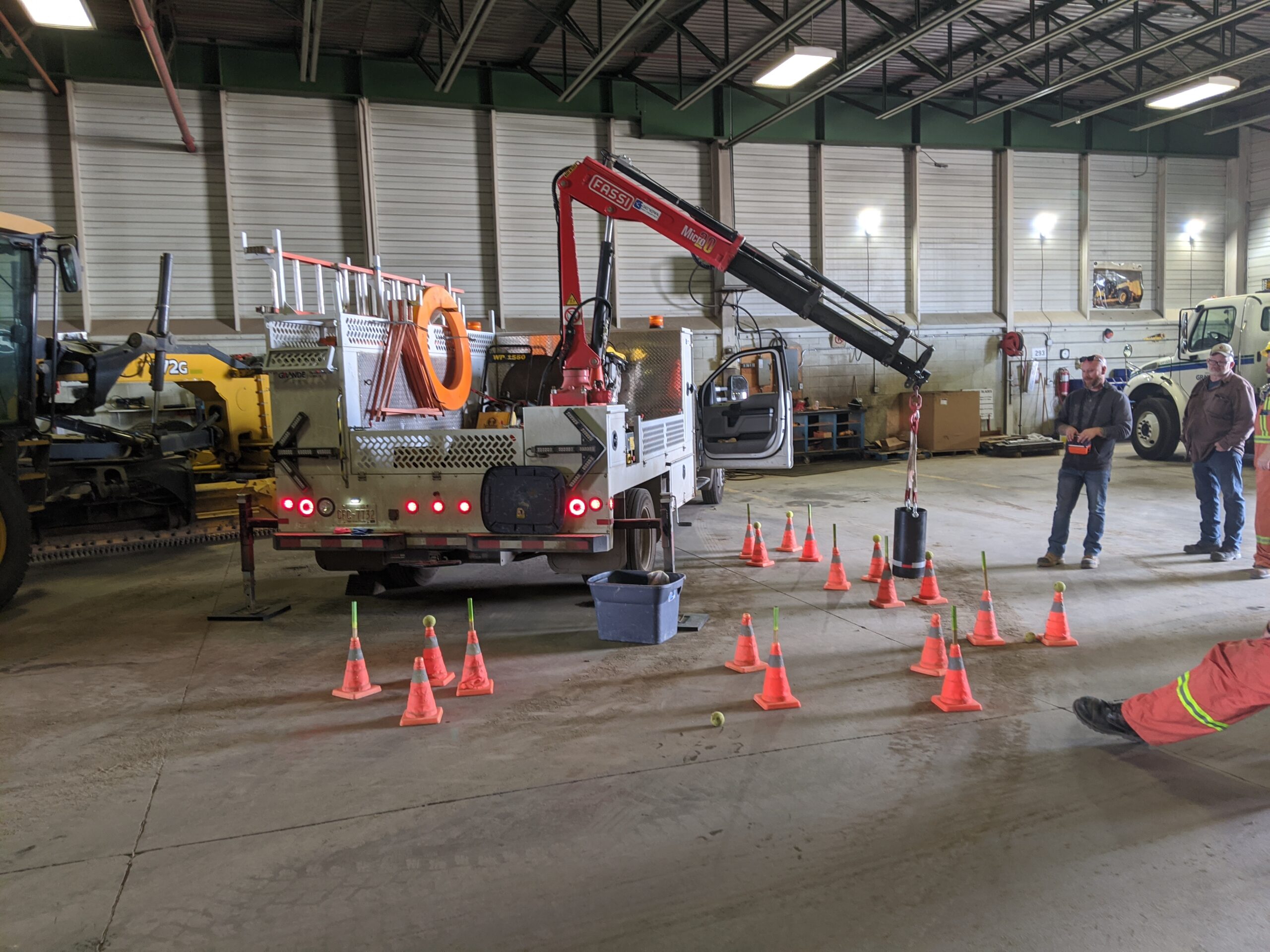
Each operator will be required to pass the theory exam (85% required) and then a practical assessment is also done as shown, to include:

  • Proper positioning while operating the crane
  • Load theory
  • Load placement
  • Weight calculation (basic)
  • Stability
  • Inspection
  • And much more.

Upon completing our light program your operator will receive a wallet card and certificate.

Contact us – send an email to us HERE requesting more details.

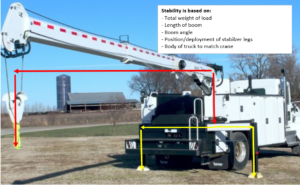
Mechanic Service Crane Stability

Mechanic Crane Stability is a topic we get all the time and unfortunately it’s also the least understood.

Many operators simply don’t understand the dynamics of crane stability well enough as they often don’t use the stabilizer on the mechanic service cranes at all!

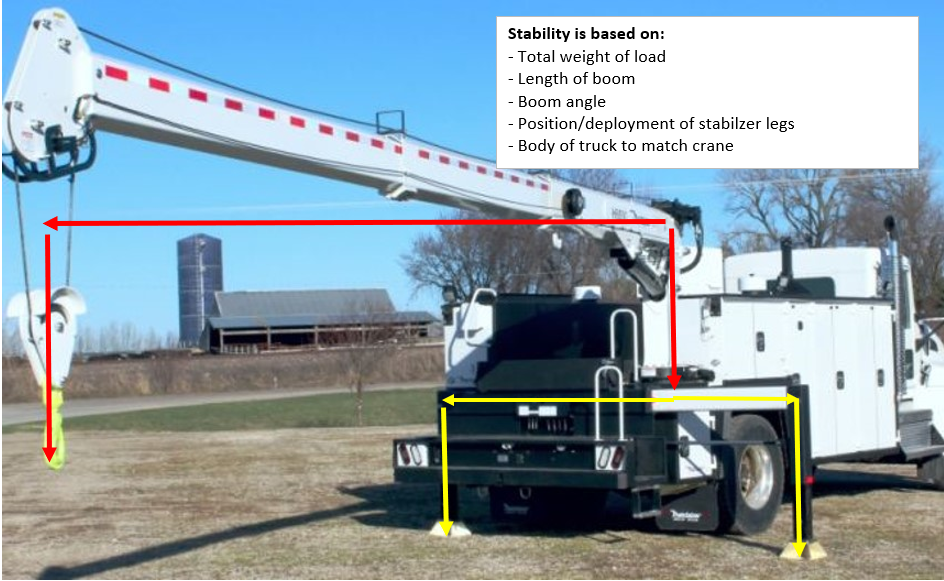
There seems to be a threshold of when to use them properly and when it’s ok to “short-jack” the crane as they are lifting under xxx weight.  Ok so how does this get so confused anyway?  Lets look at the reason for stabilizer deployment in the first place:

  1.  These are not “outriggers”, often a term used for the 2 legs that are deployed to prevent an unsafe lift.  Outriggers are typically used on larger cranes where there are 4 in total used to lift the crane up and unload the suspension of the crane for added counter ballast.
  2. The stabilizers are designed to simply stabilize the truck during the lift and prevent unsafe crane operation

Now we won’t split any hairs here, call the as you wish, we are simply working on the “why” not the “what”.  

So these smaller cranes typically will be installed by a service body installer as it’s not complicated stuff at all.  Then the body builder will take the unit once complete and do a stability test on it based on the SAE J765 standard of testing.  Also the crane manufacturer will provide all the details on how this is to be done AND recorded.

Now, given all that, when an owner or operator takes this out into the field, this is when it goes from good to not so much.  So what do I mean?
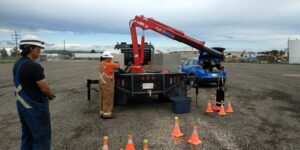
small crane training Lets assume the operator is working on a wheel loader with a transmission removal work order and the crane has to lift inside a cab.  Also it’s been raining out for a few days and the ground is soft.  So the transmission weighs in at 4,000 pounds, the crane is 6′ away from the unit and the operator DOES have both legs on the ground, life is good right!  

What about the soft ground beneath the crane and lack of stabilizer pads on that same soft ground?  Then the service body was changed to a taller one vs what the crane manufacturer recommends it to be for proper stability?  Note the taller the service body on a standard F550 Super duty (or chassis of preference) does impact the overall stability, taller bodies vs. shorter ones.

The technician lifts the transmission successfully out of the cab and swings it to the right and fails to have pulled out the moveable leg underneath the crane and pulls the truck over.  Now it sounds far fetched but is very much a situation we’d heard about a few months back.

How does someone forget to deploy the moveable leg on such a heavy lift?  Habits my friends, habits also tied to the fact that many of these little mechanic service cranes have manual out and manual down stabilizers for a “cost savings” and given the fact the over the course of 6 months, the stabilizer beam (the part the leg is attached to), gets packed with road debris over time and makes it very difficult to pull out for proper use, the technicians give up on keeping it clean and operational.  

I’ve been in the field and know this first hand, while it does not make it even remotely right, I see the struggles they have and this is why I’m not a fan of the cheaper manual stabilizer leg kits.

Bottom line, how you do one thing is how you will do everything and if you continue to operate the crane in what is an unsafe manner, you will at some point, have an incident with the crane, recordable or not, it is preventable. Mechanic Service Crane Stability is not something you want to short cut on at all, there are far too many video on YT or other platforms that show what is the most often mis-used tool there is!

We now have an instructor led, virtual training program for these cranes, it has a theory section as well as practical that must be completed in order for you to become a certified operator.  Contact us for details and pricing HERE.