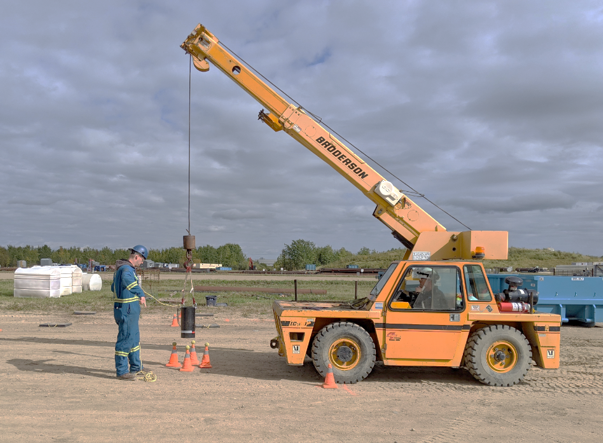
Carry Deck Crane Operator Safety Training in Alberta and Saskatchewan
Light Duty Crane Safety provides on-site carry deck crane operator safety training for employers using compact industrial cranes in shops, yards, plants, refineries, maintenance facilities, construction support work, and industrial environments.
This program is designed to support employer training records, operator familiarization, written knowledge assessment, and basic practical evaluation for carry deck crane operation.
Final operator authorization, supervision, site-specific familiarization, and determination of worker competency remain the responsibility of the employer.
On-Site Carry Deck Crane Training
Carry deck cranes are compact, useful, and easy to underestimate. Their short wheelbase, rotating boom, deck load, steering configuration, travel limitations, and pick-and-carry use can create serious stability and control hazards when operators are not properly trained.
Our carry deck crane training focuses on practical field-level operation, including crane setup, load chart awareness, deck loading, travel limitations, stability, communication, inspections, and safe operating practices.
This is not trade qualification training, rigging certification, engineering review, or employer competency certification.
Who This Program Is For
This program is intended for employers with workers who operate or supervise compact industrial cranes, including:
- Carry deck cranes
- Pick-and-carry cranes
- Broderson-style industrial cranes
- Shuttlelift industrial cranes
- Grove industrial cranes
- JLG industrial cranes
- Plant maintenance cranes
- Yard and shop lifting equipment
- Compact industrial cranes used in refineries, plants, shops, yards, and construction support environments
Common models may include Broderson IC-20, IC-35, IC-80, IC-100, Shuttlelift, Grove, JLG, and comparable compact industrial cranes.
Course Format
This is typically delivered as a one-day on-site program using the employer’s crane, work area, manufacturer information, and site procedures where available.
The training day normally includes:
- Instructor-led classroom theory
- Crane-specific hazard discussion
- Written knowledge assessment
- Practical operator evaluation
- Training completion documentation
- Employer record support
Program length may vary depending on class size, crane type, site conditions, operator experience, and the number of operators being evaluated.
Theory Topics
The classroom portion may include:
- Employer and operator responsibilities
- Carry deck crane hazards
- Pre-use inspection requirements
- Manufacturer instructions and limitations
- Load chart and radius awareness
- Rated capacity and configuration limits
- Deck load capacity and load placement
- Pick-and-carry limitations
- Steering and travel hazards
- Dynamic versus static loading
- Ground conditions and travel path review
- Swing, boom extension, and rotation hazards
- Outrigger or stabilizer use, where applicable
- Suspended load control
- Communication and hand signals
- Exclusion zones and site control
- Shutdown and parking procedures
- Documentation expectations
A written knowledge assessment follows the theory portion.
Practical Evaluation
The practical portion may include observation and evaluation of:
- Pre-use inspection process
- Review of crane markings and rated capacity information
- Setup and work area awareness
- Load chart or capacity chart use
- Basic hoisting and lowering control
- Boom movement and rotation control
- Load placement
- Travel path awareness
- Pick-and-carry limitations, where applicable
- Communication with a signaler
- Shutdown and safe parking
The practical evaluation is a basic training evaluation. It does not replace the employer’s responsibility to determine whether the worker is competent and authorized to operate the specific crane for assigned work.
Important Scope Limitation
Light Duty Crane Safety provides carry deck crane operator safety training, written testing, practical evaluation, and training documentation.
We do not certify legal competency. We do not provide rigging certification, engineering approval, lift-plan approval, equipment inspection certification, or trade qualification.
The employer remains responsible for confirming legal requirements, maintaining equipment, reviewing manufacturer instructions, supervising the work, authorizing operators, and determining worker competency.
What the Employer Provides
The employer should provide:
- A suitable carry deck crane with current NDT certification
- The crane’s operator manual or load chart information
- A safe training area
- A representative load, where appropriate
- Site-specific procedures, where available
- Any company pre-use inspection forms
- PPE required for the site
- A supervisor or employer representative, where practical
What Light Duty Crane Safety Provides
Light Duty Crane Safety provides:
- Instructor-led carry deck crane safety training
- Written knowledge assessment
- Basic practical evaluation
- Training completion certificate
- Wallet card, where applicable
- Training records for the employer’s safety file
Alberta and Saskatchewan Training Documentation
In Alberta, the employer is responsible for ensuring lifting devices are operated only by competent workers authorized by the employer.
In Saskatchewan, crane operators must be trained and have written proof of training readily accessible while operating the crane.
Our carry deck crane training documentation is intended to help employers support those records. It does not transfer the employer’s legal responsibility to Light Duty Crane Safety.
Capacity and Trade Qualification Note
Some crane types, capacities, provinces, and work scopes may require a trade-qualified or otherwise specifically credentialed operator.
Employers are responsible for confirming whether their carry deck crane, lifting application, jurisdiction, or worksite requires a trade qualification, apprenticeship credential, client-specific approval, or additional training beyond this program.
If your crane is over the applicable light-duty threshold or is being used in a regulated work scope, confirm the requirements before scheduling training.
Book Carry Deck Crane Safety Training
Light Duty Crane Safety provides mobile, on-site carry deck crane operator safety training in Alberta and Saskatchewan.
- Call / Text: 587-209-2589
- Email: info@knuckleboomtraining.ca
Use the contact form to request training dates, location, crane type, number of operators, and any site-specific requirements.
General Disclaimer
This page provides general safety training information only and is not legal advice. Crane operation requirements vary by province, crane type, crane capacity, employer, client site, manufacturer instructions, and assigned work. Employers are responsible for confirming current legal requirements, determining worker competency, authorizing operators, providing supervision, and ensuring compliance with applicable OHS legislation and site procedures.
Support your operator development and documentation requirements with onsite training and evaluation..
Back to all light duty crane training programs
Read our FAQ for employer requirements and documentation
If your crane exceeds the scope of this program, additional provincial regulatory requirements may apply.
Employers should review the applicable provisions of the Skilled Trades and Apprenticeship Education Act and associated regulations regarding mobile crane operation.
