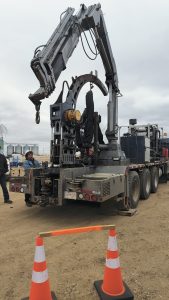
Alberta Picker Truck Operator Certification

Crane operator safety is of paramount importance in Alberta and for matter, all of Canada.

To ensure the well-being of operators and minimize workplace accidents, it is crucial for companies to prioritize safety training and certification. This post aims to shed more light on the significance of light duty crane operator safety and provide insights into the certification process in Alberta.

In Alberta, light duty crane operators must adhere to specific regulations to ensure safe operations. For instance, knuckle boom cranes (articulated loader, picker trucks) must not exceed 8 tons in lift capacity. To help companies meet these safety requirements, there are specialized training programs available. One such program is offered by Light Duty Crane Safety Programs, which provides crane-specific, operator safety certification. These programs are completed on-site, anywhere in Western Canada, and are up to 1-day in duration. They cover various types of light duty cranes, including knuckle boom cranes, carry deck cranes, mechanic service cranes, and mini crawler cranes. Upon successful completion of the program, operators receive a laminated wallet card, a certificate of completion, and a 3-year renewal.

Investing in light duty crane operator safety training offers numerous benefits to companies. Firstly, it ensures that operators are well-versed in safe, proper, factory-style crane operating procedures. This knowledge helps prevent accidents and promotes a culture of safety within the organization. Additionally, providing certified training to operators demonstrates a commitment to employee well-being and compliance with regulatory standards. By equipping operators with the necessary skills and knowledge, companies can enhance productivity, reduce downtime due to accidents, and maintain a safe work environment.

To find out more about our Alberta picker truck certification, contact us HERE or call us at (587)209-2589

Please note that this blog post is a general overview and should not be considered as legal advice. For more detailed information, it is recommended to consult the relevant authorities and regulations in Alberta.

New Boom Truck Standards in Alberta

While not new, they are updated and it once used to be a mobile crane up to 8-tons in capacity is now 5-tons or to paraphrase:

In ALBERTA:

Certification is required when operating:

  • Booms (including telescoping booms and articulating booms possessing live lines) capable of swinging, hoisting and booming up and down with a lifting capacity of greater than 5 tons (4.5 tonnes) and equal to or less than 65 tons (59 tonnes)

So how do you interpret this information?

  1. For telescopic straight boom cranes, the lift capacity is based on the winch installed on the crane, the manufacturer specifications but in most cases (always refer to your specific crane information), winches are typically ‘limited’ to 9,000 pounds SINGLE LINE PULL rated capacity.
  2. In the case of a Broderson IC80-3.  This is what is classified as a mobile crane with a lift capacity of *18,000 pounds, over the front only and on outriggers using a 2-part hook block to obtain this capacity. See load chart HERE for more.
  3. If you do not have or use a 2-part hook block as originally supplied by the manufacturer, your capacity in a single part configuration, using the 90-pound down-haul weight, your stated capacity is now 9,000 pounds no matter where on the load chart you are as a maximum lift capacity.
  4. This is not a lesson in reading a load chart, however you would need to understand lift dynamics, load weight, radius, outrigger position, etc to ensure you are lifting within the capacity of the crane.
  5. Your LMI/RCI (load moment indicator-Rated capacity indicator), must also be current as in calibrated within the last 365 days to ensure accuracy, however knowing the weight of the load is not an option, it is a must.
  6. You must also know your tire type (air, foam filled-solid rubber), PSI of tire, etc to understand on-rubber, pick and carry as well as on outriggers, over the front and over the side.

Do you need a trade registered operator at the controls for this crane then?

If you are NOT using nor have any access to a 2-part hook block, be it available in a shop hanging on the wall, or in the front trunk area of the crane, you are then limited to a reduced capacity or UNDER the 5-ton threshold of lifting.

So for companies that have pipe-fitters/steam-fitters operating the crane you DO need to provide a form of equipment specific training as outlined in Alberta OHS Section 6, 59(1) HERE, where; “This Part applies to lifting devices, including cranes and hoists, with a rated load capacity of 2000 kilograms or more.”

It does not mean you do nothing either, this is the worst scenario.

We highly recommend you obtain specific training for any equipment you offer your employees, as well as in the case of cranes of any type, a rigging course should also be offered to those working with the cranes to ensure proper knowledge of hoisting and rigging.

As always, there are many brands of carry deck cranes on the market place today, it is up to you to identify your crane type, winch capacity, operator requirements and always confirm by contacting both OHS officers as well as your location AIT centre to ensure you have all the latest information available.

For information regarding this or any of our programs, please do not hesitate to contact us at (587) 209-2589 or send us an email HERE.


Crew Truck Picker Certification Program

We offer a 1-day, crew truck picker certification program that allows you to bring us to your location, use your crane to keep the operators familiar with the crane type, and then once they pass the exam and practical evaluation, the operators will be certified UP to the the Provincial weight restriction allowance, which I’ve outlined below for reference.

Weight Restriction on Pickers by Western Province:

  • Alberta -> Up to 8-tons in weight capacity (or 5-tons if you add or have a boom winch installed that has a 5-ton, single part line pull capacity).
  • B.C -> Up to 5-tons in maximum lift capacity
  • Saskatchewan -> Up to 5-tons maximum lift capacity, no boom length restriction as there is in B.C.

Brands of pickers we provide certification on are:

  • Palfinger Knuckle boom cranes
  • Hiab knuckle boom cranes
  • Fassi Knuckle boom cranes
  • Ferarri knuckle boom cranes
  • Amco Veba knuckle boom cranes
  • Copma knuckle boom cranes
  • HC knuckle boom cranes
  • All cranes that have remote controls are also included

Picker Certification Program Overview:

3.5 hours of theory in the morning session covering items such as ->

  • Load chart identification and how to read and interpret
  • Stability and proper use of stabilizer system of the picker, also what happens if you don’t do it right
  • Crane components and how to use them properly
  • OHS standards
  • CSA standards
  • What is an NDT certification and how does it apply to cranes and what it isn’t
  • Operator responsibilities
  • Company responsibilities
  • Remote control process with knuckle boom pickers

Afternoon practical evaluation will include the following items and more not shown below:

  • Pre-use inspection items
  • Proper set up process
  • Proper sizing of stabilizer pads (yes one size does not fit all)
  • Proper sequence of unfolding and folding the picker (why accidents happen more often in this process)
  • Proper crane positioning
  • Proper operator position (manual controls and remote control location)
  • And significantly more

For reviews of our program please click HERE

To contact us for training, please call (587) 209-2589

*We may be in a training session, please leave a message if you get our voice mail, your call is super important to us

Send us an email HERE

*NOTE – this program does NOT include any rigging certification aspect.


Coil Tubing Crane Operator Training

If you operate a #CoilTubing unit and are looking to get your operators certified in Alberta, look no farther than our on-site picker safety training and certification.

We come to your shop and put on our one-day picker program so that your operators will obtain the most current standards set out by CSA as well as Provincial OHS standards.

The morning theory session will be 4 hours in length and there is an exam at the end of the morning session.  We then typically bread for 45-minutes for lunch and immediately afterwards the practical evaluation will begin.

Typically there is not a lot of room on a coil tubing unit for full use of the boom but we make it work so that we can if the boom has enough extension available.

We do a full visual boom inspection and show your operators what they need to be aware of and look for on a boom, load hook, as well as stabilizers and controls of the crane.

We also show them the most critical areas they must be looking at prior to using the crane.  It has become the industry standard in safe use procedures.

Give us a call at (587) 209-2589 to discuss our Coil Tubing Crane Operator Training program, costs and details or send us an email to info [at] KnuckleBoomTraining.ca, our response time is within 2 hours of your email.


Light Duty Crane Training in Alberta: Importance of Knuckle Boom Crane Training and Proper Crane Operation

In Alberta, Canada, the safe operation of cranes is governed by the Occupational Health and Safety (OHS) Act and Regulations. It is essential to provide light duty crane training in Alberta, including knuckle boom crane training, to ensure the safe operation of cranes in the workplace. Under OHS requirements, employers must provide adequate training and supervision to ensure the safe operation of cranes, including knuckle boom cranes, which have a hydraulic system that allows the boom to bend and flex, making them ideal for working in tight spaces or with awkward loads.

Knuckle boom crane training covers a range of topics, including crane stability, load calculations, and proper use of the hydraulic system. Operators learn about the potential hazards of working with cranes, such as overhead power lines and unstable ground conditions. By providing knuckle boom crane training, employers can ensure that their operators have the skills and knowledge needed to operate the crane safely and efficiently.

Proper crane operation is essential for workplace safety. Workplace accidents involving cranes can result in serious injury or death, as well as damage to property and equipment. Therefore, it is crucial to follow OHS regulations for crane operation, including regular inspections and maintenance of the crane, as well as proper training for all crane operators.

Unfortunately, some companies opt out or wait until it’s too late to provide proper crane operator safety training. Some employers believe that on-the-job training or general safety training is sufficient, while others think that investing in training is too expensive or time-consuming. However, the consequences of inadequate training can be severe, including workplace injury or death to crane operators or other workers on the job site.

Employers have a legal and moral responsibility to ensure the safety of their workers. By investing in proper knuckle boom crane training and following OHS regulations for crane operation, employers can protect their workers from harm and reduce the risk of accidents on the job site. Ongoing training and support to crane operators are essential to ensure that they have the skills and knowledge needed to operate the crane safely and efficiently.

In conclusion, proper crane operation is critical to workplace safety, and employers in Alberta must provide adequate training and supervision to ensure the safe operation of cranes. Providing light duty crane training in Alberta, including knuckle boom crane training, is essential to ensure the safety of workers. By investing in proper training and following OHS regulations for crane operation, employers can protect their workers and reduce the risk of workplace accidents.

Crane Stability – Why it’s Often Misunderstood by Inexperience

Crane Stability is a critical aspect of safe lifting operations and inexperienced operators on light duty cranes (cranes that don’t require a trade operator at the controls), often misjudge the weight and factors at play on the smaller picker trucks.  It’s generally misunderstood by inexperience in operators.

Ensuring the stability of a crane during a lift helps prevent accidents and protects workers, equipment, and materials.

Here are a few key reasons why proper crane stability is so important:

Stabilizers are often referred to as outriggers and while I won’t split hairs at all, most don’t really understand the diffrernce between stabilizers and outriggers, let me quickly define them:

Stabilizers – are typically installed on smaller cranes, knuckle booms, service cranes, etc, where the full weight of the truck is held but NOT releasing or lifting the chassis up or off the ground.  The smaller cranes don’t have the cross section build of the larger cranes that WILL take the entire weight of the unit and lift the chassis (Carrier) up off the ground.  Smaller cranes that are installed on the trucks may only have 2 or 4 stabilizer legs to help…well stabilize the chassis.

Outriggers – are typically much larger cross section, are attached to much larger outrigger beams (the part that comes out from the base of the crane), can take much higher forces.  These cranes also have an LMI/RCI in the cab that you can program the position of the outriggers and based on that information, will either give the crane full lifting capacity or reduce the lifting capacity based on how much stability the crane has.

Maintains Proper Load Balance: Proper crane stability helps keep the load balanced, reducing the risk of equipment tipping over or dropping the load.

Prevents Structural Damage: An unstable crane can cause structural damage to itself and surrounding buildings, which can be costly to repair.

Increases Efficiency: A stable crane is able to lift and move heavier loads, increasing efficiency and reducing the time required to complete the job.

Enhances Safety: The stability of a crane helps prevent accidents, ensuring that workers are protected from harm and that equipment is not damaged.

Compression Force: The weight of the load being lifted is directly applied to the stabilizer leg, which creates a compression force on the leg. This force must be taken into account when determining the size and strength of the stabilizer leg required for the lift.

Tension Force: The crane’s outriggers are designed to provide support and counteract the weight of the load being lifted. When the load is directly over a stabilizer leg, the outrigger provides additional tension force to the leg to ensure stability.

Bending Moment: The combination of compression and tension forces applied to the stabilizer leg creates a bending moment, which can cause the leg to bend or buckle under the stress of the load.

Stabilizer legs are an essential component of cranes, providing stability and support during lifting operations. When the load being moved is directly over one of the stabilizer legs, the forces applied to that leg can be significant and can have a major impact on the safety and success of the lift.

It is important to properly calculate the forces applied to the stabilizer legs to ensure that the crane is able to handle the load being lifted. Factors such as the weight of the load, the height of the lift, and the crane’s capacity must all be taken into account to determine the required size and strength of the stabilizer legs.

We spend a lot of time talking about proper stability, proper use of the stabilizer legs as they are an essential foundation of cranes and play a critical role in ensuring stability and safety during lifting operations. When the load being moved is directly over a stabilizer leg, the forces applied to the leg can be significant, and proper calculations must be made to ensure the safety and success of the lift.

To ensure proper crane stability during a lift, it’s not only important to follow manufacturer guidelines and industry standards, it’s even MORE important to make sure all your operators understand that by NOT using the stabilizers properly on the crane, that it’s a violation of your SOP, lift standards and most of all…their agreement with their family to come home every night.

While we go into the reasons, we simply can’t provide the operator with all of the load calculations, outrigger forces at play and such, it IS up to you, the owner of the business, the employee who operates the crane and really…anyone who is involved with lifting to be a clear as possible, DO NOT MESS WITH the position of the stabilizers unless the math has been completed and signed off on.

Contact me for more details and for training HERE