Crane Safety Procedures: When Shortcuts Become Normal
“We’ve done it this way a hundred times, and nothing went wrong.”
Most experienced workers have heard some version of that sentence.
In crane operations, it should get our attention.
Not because the person saying it is necessarily careless or inexperienced. In fact, the opposite can sometimes be true.
They may have completed the same task dozens or even hundreds of times without an incident.
The problem is that past success does not automatically prove that the procedure was safe.
Sometimes it simply means the consequences haven’t caught up with the shortcut yet.
This gradual acceptance of unsafe practices is often called normalization of deviance.
What Is Normalization of Deviance?
Normalization of deviance happens when a shortcut, procedural change, or departure from an established safe practice does not produce an immediate negative result.
Nothing happens.
So we do it again.
Nothing happens the second time either.
Eventually, what originally felt like a shortcut begins to feel normal.
The operating boundary slowly moves.
What started as:
“We’ll just do it this way once.”
can eventually become:
“This is how we’ve always done it.”
That change can be difficult to recognize because it doesn’t normally happen all at once.
It happens one decision at a time.
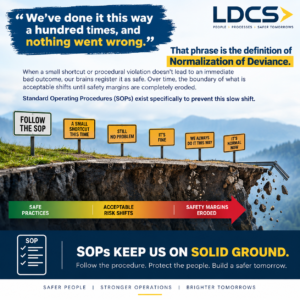
What Does This Look Like in Crane Operations?
In light-duty crane operations, normalization of deviance doesn’t always involve an obviously reckless decision.
It can start with something small.
For example:
- Skipping part of the pre-use inspection because the crane was fine yesterday.
- Not fully deploying stabilizers because the load appears light.
- Accepting a questionable setup because the same lift was completed previously.
- Estimating load weight instead of confirming it.
- Ignoring a change in operating radius.
- Setting up closer to an excavation, slope, obstruction, traffic area or other hazard than normal.
- Using a familiar crane without taking the time to confirm its particular configuration or controls.
- Continuing an operation after site or ground conditions have changed.
Individually, these decisions may seem minor.
The danger develops when repeated success begins to convince us that the shortcut itself is safe.
The Crane Doesn’t Know You Have Done It Before
A crane does not know that an operator has performed the lift 100 times.
The physics involved haven’t changed because the operation is familiar.
Load weight still matters.
Operating radius still matters.
Configuration still matters.
Ground conditions still matter.
Stability still matters.
And conditions that were acceptable during yesterday’s lift may not be acceptable today.
A different load position, slightly greater radius, softer ground, partially deployed stabilizer, different crane configuration or small change in site conditions can change the operating situation considerably.
That is why experience should support good crane safety procedures — not replace them.
Why Crane Safety Procedures Matter
Standard Operating Procedures, manufacturer instructions, inspections, load charts and site-specific procedures provide something extremely important:
A consistent operating boundary.
Without that boundary, acceptable practices can gradually shift.
Consider the progression:
Safe procedure
↓
Small shortcut
↓
Nothing went wrong
↓
Shortcut repeated
↓
Shortcut becomes accepted
↓
“We’ve always done it this way.”
The absence of an accident does not automatically mean the decision was correct.
It means there was no accident.
Those are not the same thing.
Experience Is Valuable — Complacency Is Different
Experienced crane operators bring tremendous value to a workplace.
They understand equipment behavior.
They recognize changing site conditions.
They often identify potential problems before less experienced operators see them.
But experience can create another challenge.
Familiarity can make unusual conditions appear routine.
A task that once demanded careful consideration can gradually become something we perform almost automatically.
That is why experienced operators still need to stop and ask:
“Is today’s lift actually the same as yesterday’s lift?”
Look again.
Has the load changed?
Has the radius changed?
Has the crane configuration changed?
Has the ground changed?
Are the stabilizers positioned correctly?
Has traffic or site activity changed?
Are there new overhead hazards?
Are we still operating within the manufacturer’s requirements and workplace procedures?
A two-minute reassessment can reveal something that familiarity caused us to overlook.
Three Fundamentals Still Apply
At Light Duty Crane Safety, we repeatedly return to three basic operating principles:
1. Stability
What is supporting the crane today?
Ground conditions, stabilizer placement, machine position and surrounding conditions all influence crane stability.
2. Configuration
How is the crane configured for this particular lift?
Boom position, extension, stabilizer configuration and other equipment-specific factors can affect allowable capacity.
3. Operation
Is the operator using the crane within the manufacturer’s instructions, load chart and established workplace procedures?
These fundamentals don’t disappear simply because the operation has been completed successfully before.
Supervisors and Employers Need to Watch for It Too
Normalization of deviance isn’t only an operator issue.
Workplace culture matters.
When supervisors repeatedly overlook shortcuts because production continues and no incident occurs, those shortcuts can gradually become unofficial workplace procedures.
That creates a dangerous message:
“Management sees us doing it, so it must be acceptable.”
This is why employers and supervisors should periodically review actual field practices — not simply assume written procedures are being followed.
There can be a significant difference between the procedure written in a manual and the procedure that has gradually developed in the field.
A Better Question to Ask
Instead of asking:
“Have we done this before?”
Ask:
“Are the conditions right to do it safely today?”
That small change in thinking matters.
Crane safety isn’t about assuming every lift is dangerous.
It is about recognizing that conditions can change — and making decisions based on the lift in front of you rather than the lifts behind you.
Training Should Reinforce Good Habits
Effective crane operator safety training should do more than explain controls and equipment.
It should reinforce the decision-making process operators use before and during a lift.
Operators should understand why procedures exist and how changes in stability, configuration and operation can affect the crane.
The goal isn’t to remove operator experience from the equation.
The goal is to combine experience with consistent safe operating practices.
Because one of the strongest things an experienced crane operator can say is:
“We may have done it that way before, but is it still the right way to do it today?”
Light Duty Crane Operator Safety Training
Light Duty Crane Safety provides on-site operator safety training for light-duty crane applications in Alberta and Saskatchewan, including:
- Knuckle boom and articulating cranes
- Carry deck cranes
- Mini-crawler and spider cranes
- Mechanic service-body cranes
Our programs focus on the fundamentals operators need to understand when working with these types of cranes, including Stability, Configuration and Operation.
Control the Lift. Control the Risk.
Learn more about Light Duty Crane Safety training programs or contact us to discuss training for your operators.