I recently posted a brief summary on how to read load charts on Linkedin. You can see it HERE.
However I did not go into great detail on how to read knuckle boom crane load charts, I simply went over the “other” information that they provided.
So ill go into greater detail, but still in short form here so that that there is greater clarity. Because we specialize in light duty knuckle crane training, the information applies directly to that type of crane.
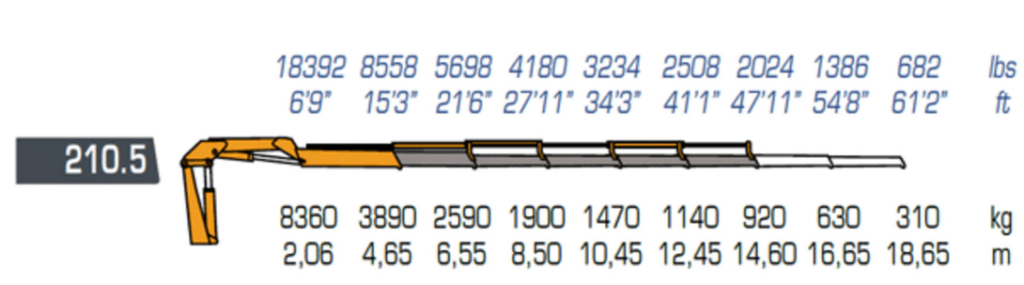
The one dimension load chart above shows the following information:
- Crane model – 210.5 or 21.5 Meter/tonne rated crane NOT a 21-Ton crane
- Shows the capacity of the crane in both metric and imperial capacities
- When you look at the first initial pick on the left side, it really shows the true capacity at 18,932 pounds (makes it a 9 Ton Crane)
- When you look closer at the chart, the last two extensions of the crane (shown in white filler), are in fact manual extensions only or manual pull outs. IF the crane is not equipped with these, the load chart should be changed to reflect this, but they are NOT hydraulic extensions
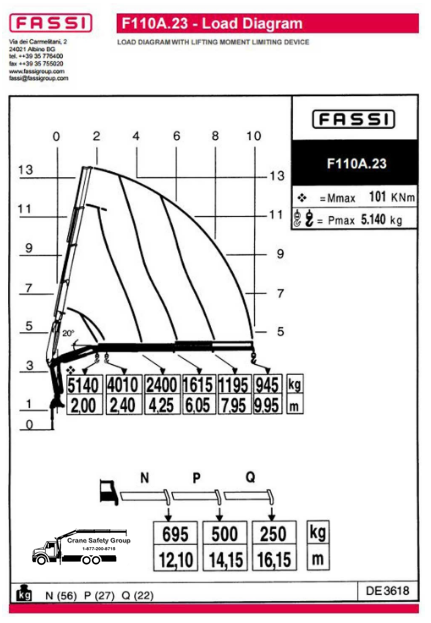 This 2-dimensional load chart has much more information for the operator to view such as:
- X and Y axis, show not only distance from the crane, but vertical height as well. This is especially important when lifting above 15′, as it shows the “curved” load of the crane during the lift. As with most cranes that use a winch, they will provide a much more vertical (straight up and down) than most knuckle boom cranes will.
- Showing that in order to lift the maximum with this particular crane, the operator will be required to physically move the load hook to its innermost position or hook support to be able to pick this weight.
- The load chart also shows the “manual boom extensions” shipped with the crane in white at the bottom. These are actual capacities of each of the extensions separately. Meaning you do not want to lift more than they are rated for as this may result in bending of these individual sections. Damage to the crane, load and much worse may happen to the operator.
- The load chart also shows, if you look very closely on the left side, a figure in “degrees”. In this case, it shows a 20-degree inner to outer boom angle, reflective of proper load moment rating of the crane.
How to read the darn chart now…well with other types of cranes, mainly stiff boom or hydraulically telescopic boom cranes, the load is show in 5′ increments (typically but not always), and with the knuckle boom crane it’s typically (but not always) shown at the end of each boom section, fully extended, so not every 5′.
The easiest way I tell folks we train is this: 1. KNOW HOW MUCH THE DARN ITEM weighs before you pick it up (if you are not sure, go HERE). 2. Once you know the weight of the item, lets say it’s a 2,000 pound tote. The first load chart on this page, shows you can lift to an effective distance of 47′ 11″ from the centre of the crane rotation system away. ON the bottom load chart, as it’s in metric, we need to convert either from or to, so in this case a 2,000 pound tote is 909 KG, your effective distance from the centre point of the crane rotation system is 9.95 metres away. We know that by the numbers we can go a bit further away, however I stress this that the stability of the crane truck may be compromised long before reaching the capacity/distance is.
As there is a lot of information given on a load chart, WE highly recommend you have your operators become very familiar with them and if they have been obliterated by the pressure washer, you do leave yourself liable if an operator has in incident and did not know any information necessary to perform a safe lift. It’s really not difficult to understand these charts, if there is any question feel free to contact us HERE
 This particular one while completely avoidable, took the life of a 40-year old Yonkers, NY man. He had a family, he had some of the best equipment in the industry insofar as knuckle boom cranes are concerned (HIAB is one of the top tier brands), and yet this incident reminds us of the need for a big push on tighter regulations in the crane industry in North America.