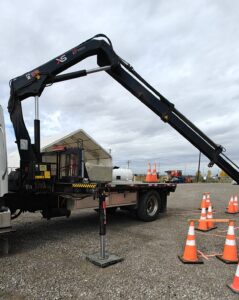
Light Duty Picker Truck Training in Alberta (2026 Guide)

Picker Truck Training Alberta (2026 Guide)

light duty crane training in Alberta

If your operators are using a picker truck in Alberta, this isn’t optional — it’s a legal requirement.

Under Alberta Occupational Health and Safety guidelines, any operator using a crane capable of lifting over 2,000 kg must be properly trained and competent.

Miss that requirement, and you’re not just risking a fine — you’re risking:

  • equipment damage
  • lost-time incidents
  • liability exposure that can exceed six figures

This page breaks down exactly what you need to know — without the fluff.


What Alberta Law Actually Requires

Under current OHS legislation:

  • Operators must be trained and competent
  • Employers are responsible for ensuring safe operation
  • Equipment must be used within manufacturer load limits

That “2,000 kg rule” comes directly from your crane’s load chart — typically the first number on the far left.

If your crane exceeds that:
👉 Training is not optional
👉 Documentation must exist
👉 Competency must be defensible


Who Needs Picker Truck Training?

If your company operates in any of the following, you’re expected to comply:

  • Oilfield maintenance
  • Construction and framing
  • Building supply delivery
  • Municipal operations
  • Utility and service work

Whether it’s called:

  • picker truck
  • knuckle boom
  • HIAB
  • folding boom crane

…it all falls under the same expectations.

👉 Call / Text: (587) 209-2589

👉 Send us an Email


What Happens If You Don’t Train Operators?

Here’s the reality most companies ignore:

One incident involving a light-duty crane can lead to:

  • Equipment loss: $150,000+
  • Site shutdowns
  • WCB claims
  • Insurance increases
  • Legal exposure under OHS

And the first question asked is always:
👉 “Was the operator trained?”

If the answer is unclear — you’re already in trouble.


What Our Training Covers

We offer structured programs based on your operational needs:

1-Day Program (Most Common)

  • Core safety principles
  • Load charts and crane limits
  • Rigging basics
  • Safe lifting practices
  • Hands-on evaluation

👉 Widely accepted across oilfield, construction, and municipal sectors


(Coming soon) 2–3 Day Advanced Programs

  • Advanced rigging
  • Load control and planning
  • Complex lifts
  • Site-specific hazard management

👉 Ideal for higher-risk environments or new operators


Industries We Work With

Our programs are used across:

  • Energy companies
  • Construction contractors
  • Municipal fleets
  • Equipment rental providers
  • Building supply companies

Training can be delivered on-site anywhere in Alberta or Saskatchewan.


Cost vs Risk (This Is Where Most Get It Wrong)

Let’s be direct.

Saving $100–$150 per operator on training:
❌ does not reduce your liability
❌ does not protect your company
❌ does not hold up in an investigation

Proper training:
✔ reduces incident rates
✔ improves operator efficiency
✔ protects your business long-term

This is not a cost — it’s risk control.


Why Companies Choose On-Site Training

  • No travel downtime
  • Training on your actual equipment
  • Real job-site scenarios
  • Immediate application

Most companies we work with want:
👉 fast
👉 compliant
👉 no disruption to operations

That’s exactly how we deliver it.


Frequently Asked Questions

Do I legally need picker truck training in Alberta?

Yes — if your crane exceeds 2,000 kg capacity, training is required under OHS.


How long is certification valid?

While Alberta does not mandate a fixed expiry, most companies follow a 3-year recertification cycle.


Is a one-day course enough?

For most experienced operators, yes. New operators or higher-risk environments benefit from longer programs.


What’s included in certification?

Theory, practical evaluation, and documentation to support operator competency.


Book Your Training or Get a Quote

If you’re running picker trucks in Alberta, this isn’t something to leave unclear.

👉 Get your operators trained
👉 Get documentation in place
👉 Remove the risk from your operation

Contact us today to schedule your training or request a quote.


TLDR (Quick Summary)

  • Picker truck training is required under Alberta OHS for cranes over 2,000 kg
  • Employers are responsible for operator competency
  • One incident can cost far more than proper training
  • One-day programs cover most operational needs
  • On-site training is the fastest and most effective option

👉 Book your training now and stay compliant

Bulk Propane Tank Setting: Light Duty Crane Safety in Alberta and Saskatchewan

The Hidden Liability in Bulk Propane Tank Setting (Alberta and Saskatchewan)

Propane Industry Pig Tanks

Bulk propane companies across Alberta and Saskatchewan move thousands of tanks every year.

420 lb pig tanks.
1,000 gallon bullets.
Skid-mounted units.
Farm tanks in muddy spring yards.
Commercial rooftop sets.

And almost every one of those lifts involves a light duty crane.

Here’s the uncomfortable truth:

Most propane companies believe they’re compliant.

Many aren’t.

Contact us to book an on-site picker safety program


Propane Is Not Just Another Lift

Setting a propane tank is not the same as lifting a bundle of lumber or a pallet of shingles.

You are lifting:

• Pressurized vessels
• Flammable product
• Often in residential yards
• Often near ignition sources
• Often on uneven ground
• Often in winter conditions

When a crane failure happens in this environment, the consequences multiply fast.

It’s not just a dropped load.

It’s:

  • Property damage

  • Environmental release

  • Fire risk

  • Worker injury

  • Public exposure

  • Regulatory investigation


What Alberta and Saskatchewan Actually Require

Many companies assume that because propane tank setting is “routine,” it doesn’t require formal crane certification.

That assumption is dangerous.

Alberta

Under Alberta OHS Code – Part 6 (Cranes, Hoists and Lifting Devices):

Operators must be:

  • Competent

  • Trained

  • Assessed

  • Able to demonstrate knowledge of load charts and safe operation

If you are using:

  • Knuckle boom pickers

  • Service body cranes

  • Folding boom cranes

You fall under Part 6 requirements.

“On-the-job training” is not a legal defense if something goes wrong.

Call / Text us (587) 209~2589 for more information

Send us an EMAIL to find out more


Saskatchewan

Saskatchewan’s Occupational Health and Safety Regulations require:

  • Adequate training

  • Documented competency

  • Safe operating procedures

  • Lift planning when conditions warrant

Saskatchewan is particularly aggressive in enforcement when incidents involve:

  • Public exposure

  • Hazardous materials

  • Transport-related lifting

Propane qualifies.


The Most Common Risk I See in Propane Operations

  1. Short-jacking stabilizers because “it’s a quick set”

  2. Ignoring reduced capacity when ground is soft

  3. Not calculating dynamic load when tank still has product

  4. No formal lift plan for tight residential installs

  5. No documented operator evaluation in years

None of this shows up… until it does.


The Insurance Problem Nobody Talks About

Here’s where it gets serious.

If there’s an incident and the investigation shows:

  • No formal crane training

  • No competency verification

  • No documented lift procedure

  • No refresher evaluation

Insurance adjusters don’t just write cheques.

They start asking questions.

And propane companies are high-profile targets.


Why Propane Companies Are More Exposed Than Most Industries

Roofers drop shingles — bad day.

Propane companies drop tanks — potentially catastrophic day.

You operate in:

  • Rural farms

  • Acreages

  • Urban residential zones

  • Commercial sites

  • Industrial yards

Your risk footprint is wide.

That makes documentation and competency critical.


The Business Case for Proper Light Duty Crane Training

This is not about tickets on a wall.

It’s about:

  • Load chart literacy

  • Stabilizer deployment discipline

  • Ground condition assessment

  • Lift planning awareness

  • Understanding dynamic load vs static

  • Recognizing when a lift becomes “critical”

When operators understand WHY — not just HOW — incident rates drop.

And so do:

  • Maintenance costs

  • Outrigger stress failures

  • Boom wear

  • Insurance headaches


Spring Surge = Risk Surge

Every year:

  • Spring thaw

  • Farm tank swaps

  • Seasonal installs

  • Staffing changes

New operators. Temporary hires. Increased lift frequency.

This is when incidents spike.

And this is when training gaps show up.


If You Run a Bulk Propane Operation in AB or SK

Ask yourself:

  • When was your last formal crane evaluation?

  • Do operators truly understand load charts?

  • Do you have lift plan criteria?

  • Can you defend your training in front of OHS?

If the answer is “we think so” — that’s not a plan.


Final Thought

Bulk propane is a disciplined industry.

Your lifting operations should be too.

The goal isn’t more paperwork.

The goal is:

  • Protecting your operators

  • Protecting your company

  • Protecting the public

  • Protecting your margins

Because one preventable crane incident in propane doesn’t just cost money.

It changes everything.


If you’re operating in Alberta or Saskatchewan and want a practical review of your light duty crane procedures — reach out.

No fluff. Just real-world application for propane operations.

Picker Truck Certification: Why Price Alone Doesn’t Tell the Whole Story

Picker Truck Certification – What Are You Actually Paying For?

When companies compare picker truck or light-duty crane training providers, the first thing they see is price.
A $150 certification looks appealing — especially when budgets are tight.

But price alone doesn’t explain what’s included, what’s missing, or how defensible that training will be if something goes wrong.

This comparison is intended to clarify the differences.


Price vs Purpose – Two Very Different Training Approaches

Not all picker truck training is designed for the same outcome.

Some programs are built to issue a certificate.
Others are built to develop operator competency and reduce risk.

Understanding which problem you’re solving matters more than the sticker price.


Picker Truck Training Comparison

Area of Comparison Low-Cost Certification Providers (≈ $150 + Travel) Competency-Focused Training Program
Primary Objective Proof of training / certification Operator competence and risk reduction
Typical Price Structure Low per-operator fee + travel Higher per-operator cost, transparent scope
Training Depth Standardized, generalized content Real-world, job-specific instruction
Load Chart Instruction Basic or theoretical overview Practical load chart interpretation using real scenarios
Stabilizers & Short-Jacking Often mentioned briefly Explicitly addressed with capacity-reduction logic
Critical Lift Decision-Making Limited or implied Actively taught and evaluated
Hands-On Operator Evaluation Minimal or checklist-based Practical assessment per operator
Supervisor / Employer Documentation Certificate only Certificate plus documented competency
Audit & Incident Defensibility Limited Designed to support due diligence
Best Fit For Box-checking and lowest upfront cost Operations with real exposure and liability

Why This Difference Matters

A certificate satisfies a paper requirement.
It does not automatically demonstrate that an operator can:

  • interpret a load chart correctly under real conditions

  • recognize when a lift becomes critical

  • understand the risk of reduced stabilizer deployment

  • make defensible decisions under pressure

Those gaps often surface after an incident or during an audit — when it’s too late to fix them.


The Hidden Cost of “Cheap Enough” Training

Lower-cost training may appear to save money upfront, but it can increase exposure in the event of:

  • a near-miss or dropped load

  • an insurance claim

  • a COR or regulatory audit

  • a supervisor or management review

At that point, the question is no longer “How much did the training cost?”
It becomes “Was due diligence actually demonstrated?”


A Straight Answer for Decision-Makers

If your goal is:

  • to check a compliance box at the lowest possible cost

a low-price certification may be sufficient.

If your goal is:

  • to reduce incidents

  • to protect supervisors and management

  • to demonstrate defensible competency

then the scope and depth of training matters more than price alone.


Final Thought

Both training approaches exist for a reason.
The key is choosing the one that aligns with your actual risk exposure — not just your short-term budget.

Ready to Get Your Crew Certified?

📞 Call/Text: 587-209-2589
📧 Email: info@knuckleboomtraining.ca
👉 Book Training: Training Contact

Why 20-Minute Picker Truck Training Fails Safety Audits in Alberta and Saskatchewan

Most picker truck operators in Alberta and Saskatchewan receive a brief orientation instead of real picker truck operator training. Learn why this fails OHS expectations—and how a one‑day, on‑site picker safety program fixes the gap.

source: HERE
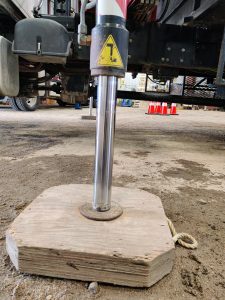

Knuckle Boom Crane Outrigger Pads

If your picker training fits between coffee and the first smoke break, it isn’t a safety program—and it won’t hold up in front of an OHS officer, an investigator, or your insurance provider in Alberta or Saskatchewan.

Across the Prairies, light duty picker trucks and knuckle boom cranes have become the default lifting solution for oilfield maintenance, utilities, municipal work, propane delivery, and construction. The risk profile of these machines has increased, but the way operators are trained often hasn’t.

This article explains why a 20‑minute picker orientation fails safety audits, what Alberta and Saskatchewan actually expect from picker truck operator training, and how a one‑day, on‑site picker safety program provides a defensible, practical solution.

source: HERE


TL;DR

  • A 20‑minute picker orientation does not meet Alberta or Saskatchewan expectations for operator competency.
  • OHS officers, investigators, insurers, and prime contractors expect documented training, evaluation, and supervision.
  • A one‑day, on‑site light duty picker safety program is often the simplest way to close the gap.

How picker training usually happens today

In many Alberta and Saskatchewan fleets, picker truck “training” still looks like this:

  • A ride‑along with an experienced operator
  • A quick walk‑around of the controls, stabilizers, and remote
  • A few verbal warnings about what to avoid
  • Then the remote is handed over and learning happens on the job

This approach is common in:

  • Oilfield maintenance and service operations
  • Municipal and public works fleets
  • Utilities, propane, and fuel delivery companies

The intent isn’t bad. Supervisors are busy, work needs to get done, and these cranes are marketed as light duty, which quietly implies lower risk.

The issue is simple: this kind of 15–30 minute orientation does not align with how regulators, clients, or insurers define competent picker truck operation.


What Alberta and Saskatchewan actually expect from picker operators

Picker trucks are not exempt from crane rules just because they’re smaller. Once you’re lifting significant loads, these units are treated as cranes or lifting devices under provincial OHS legislation.

Alberta expectations

In Alberta, picker trucks fall under the Occupational Health and Safety Code, including:

  • Part 6 – Cranes, Hoists and Lifting Devices
    Requires lifting devices to be operated safely, in accordance with manufacturer instructions, and by competent workers.
  • Part 14 – Lifting and Handling Loads
    Focuses on hazard control, load stability, and safe lifting practices.

For larger boom trucks and higher capacities, Alberta also ties into trade and apprenticeship requirements—but even light duty picker trucks still require demonstrated operator competency and supervision.

Saskatchewan expectations

In Saskatchewan, picker trucks are regulated under The Occupational Health and Safety Regulations, which apply to hoists, cranes, and lifting devices. These regulations emphasize:

  • Use of competent operators
  • Adherence to manufacturer load ratings and instructions
  • Safe handling of loads under all operating conditions

While the wording differs slightly from Alberta, the expectation is the same: operators must be trained, competent, and supported by documentation.

source: HERE
Mechanic Service body crane

Industry standards and client expectations

Standards such as CSA Z150.3 (Safety Code for Articulating Cranes) are frequently used as benchmarks by prime contractors, auditors, and insurers—especially after incidents.

Even when CSA standards are not explicitly legislated, they are commonly referenced to assess whether a company’s picker truck training program reflects recognized industry practice.

The combined message is clear:

  • Picker truck operators must be competent
  • Employers must provide structured training and evaluation
  • Training must be documented

A 20‑minute orientation does not meet that bar.


Why a 20‑minute picker orientation is not real training

When you compare a quick orientation to provincial and industry expectations, several gaps appear immediately.

1. Core crane fundamentals are missing

Short walk‑arounds rarely explain:

  • How boom extension, radius, and configuration affect capacity
  • Why ground conditions and stabilizer setup are critical to stability
  • How light duty knuckle boom cranes can still overturn trucks or damage structures

Operators are left relying on feel instead of understanding the physics keeping the truck upright.

2. Load charts are misunderstood—or ignored

Most operators have seen the load chart decal. Fewer can confidently apply it to a real lift.

Quick orientations typically skip:

  • Which chart applies to the current configuration
  • How rapidly capacity drops at longer reach
  • How to confirm a lift is within chart limits before leaving the ground

That turns every lift into a guess.

3. Rigging awareness is shallow

Without proper picker truck operator training, rigging is often treated as “whatever is on the truck.”

Operators may not:

  • Verify sling and hardware capacity
  • Recognize damaged or inappropriate rigging
  • Understand how sling angles, hitch types, and sharp edges reduce capacity

The crane may be capable—the rigging often isn’t.

4. There is no consistent evaluation

A 20‑minute orientation rarely includes a structured practical assessment. That means:

  • No consistent definition of “competent”
  • No checklist or evaluation record
  • No way to demonstrate due diligence during an audit

From an investigator’s perspective, everyone claims to be trained—but nothing proves it.

5. Documentation is weak or nonexistent

When incidents occur, three questions always follow:

  • What is your picker truck training program?
  • What training did this operator receive?
  • Can you show the records?

If the answer is informal coaching with no documentation, exposure increases fast.

If you wouldn’t be comfortable showing your current program to an officer or client, that’s your warning sign.


What a real light duty picker safety program looks like

Fixing this doesn’t require weeks away from work. A focused one‑day, on‑site picker safety program closes most gaps efficiently.

A practical program typically includes:

Classroom or meeting‑room session

  • Fundamentals of light duty crane and picker operation
  • How picker trucks fit under Alberta and Saskatchewan OHS requirements
  • Real‑world examples from oilfield, municipal, utility, and propane operations

Hands‑on training with your own equipment

  • Assessing real ground and site conditions
  • Proper stabilizer setup and cribbing
  • Reading and applying the actual load charts on your trucks
  • Walking through common lifts and identifying risk points

Basic rigging awareness

  • Identifying worn or unsuitable rigging
  • Understanding sling angles, hitch types, and edge protection
  • Building a simple, repeatable rigging check

Practical evaluation and documentation

  • Supervised setups and lifts
  • Documented evaluations
  • Training records, certificates, and wallet cards

Because the training happens on‑site with your equipment, operators connect theory directly to daily work.


Why proper picker training helps everyone

For HSE and management:

  • A clear, defensible picker truck training program
  • Documentation that stands up during audits and investigations

For supervisors and fleet managers:

  • Consistent expectations across operators
  • Faster, more effective tailgate and pre‑lift discussions

For clients and insurers:

  • Proof that picker trucks are operated by trained, competent personnel
  • Reduced risk of preventable incidents and claims

Twenty‑minute orientations are common because they’re quick. One‑day picker safety programs work because they’re consistent, defensible, and improve how work is actually done.


Next steps: move from orientation to a real program

If your picker truck training currently lives in a 20‑minute window between other tasks, it’s time to upgrade.

You should seriously consider it if:

  • You operate light duty picker trucks in Alberta or Saskatchewan
  • Operators lift around workers, the public, or client assets
  • You wouldn’t feel confident handing your program to an officer or client tomorrow

A one‑day, on‑site light duty picker safety program is often the most practical first step.

Ready to replace 20‑minute orientations with a real picker safety program?

Book an on‑site picker safety program here: CONTACT US
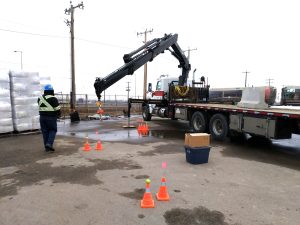
 

True Cost of Crane Incidents

The True Cost of Crane Incidents in Alberta

Crane incidents aren’t just about equipment damage – they can shut down worksites, drive up insurance costs, result in OH&S fines, and put operators at risk. Even one accident can mean days or weeks of lost productivity, ballooning costs, and legal headaches for your company.

Downtime Costs More Than Repairs

– Every hour a crane is out of service is lost revenue, missed deadlines, and frustrated clients.
– Injuries and damages typically lead to lengthy investigations, sometimes resulting in tens of thousands in fines or litigation.
– Insurance claims can raise your premiums substantially, affecting your profitability over the long run.

How Training Helps Reduce Potential Incidents

Business owners who invest in safety training see fewer incidents, saving money and time. A single dollar spent on training typically saves four to six dollars in accident and downtime costs, with indirect savings running up to ten times higher.

Get Your Business Protected today and Protect your team and business from unnecessary losses.

Contact us HERE to secure your training slot

Exams now offered in full digital format

We are offering all of our programs and exams in digital format, no longer required to use pen and paper, however the option is still there for those that are not as tech savvy.

Exam links or QR code is provided at the end of the morning training program to each student.  They will be graded automatically and provided scoring at the end of the program.