Although it’s a European chassis, it still goes to show that even with a good installation, the truck won’t stand up against a low bridge and another reason to know your travel height. The crane boom was up in the air (inner boom) and the outer boom was stowed on the deck, and luck for the operator, this was the worst of it.
Crane Outrigger Pads – Do You Need Them?
And so it goes, another crane “incident” that could have been prevented. This crane was unloading not only too close to the embankment, but did not use outrigger pads. Too much pressure on the crane outrigger leg “shoe” ended up punching a hole through the pavement and the ground beneath it was far too soft to continue to support the crane, extended boom and weight at the end of the boom, resulting in substantial damage to crane truck and surrounding area. TOTALLY PREVENTABLE. We provide a full range of outrigger pads to choose from. Why wood outrigger pads? Here is why:
- Far less expensive and renewable (yes good for the environment)
- 18″ x 18″ is the smallest we recommend (yes we know, it’s good for over 20T, BUT…the larger the pad, the more surface area to distribute the weight)
- Locally made (in Alberta) shipping worldwide
- Far less expensive than poly pads that will deflect in warm weather and thus creating a “Bowl” effect, useless pads!
In many cases, there is an assumption that there is not enough weight on the leg/shoe to worry about having to use the pad, HOWEVER in all cases it’s typically due to operator lack of knowledge, no one really spent the time to inform them of the dangers in not using pads.
Electricity and Cranes – Guess Who Wins?
This is an older post, but needless to say, the same thing continues to happen needlessly. The system asks “why” or “how” but as usual, until someone dies, no one wants to talk about “how do we prevent this?”
A 7.5 Kv powerline (service line) was contacted, it was a tight lift to begin with regardless but it may be an alternative piece of equipment may have been selected instead of this crane. The Effer crane had a jib on it, and looking at how it had to navigate those lines, as an operator, my choice (yes it’s also easy to say afterwards), that I would not have made this lift, but again, those choices are often ignored for the need to get the job done!
Click HERE to watch short video

Where’s The Line – Does This Really Work?
We’ve been HUGE advocates of line safety, we are a dealer for the SigAlarm High Voltage proximity alert systems not simply because we wanted a product line, but simply because more people need to stay away from over head power lines. I know that is the obvious statement, however it’s not that obvious.
We see the messages, the advertisements of “where’s the line”, the meaning is good, the delivery…not so much so it seems. One recent training we did, one of the students brought up a very valid point, “we are bombarded with safety stuff all day, we become desensitised to the posters” even tho they have a very strong safety culture.
Far too many people’s lives are forever altered or worse, families lives, i’d like to say “simply” due to a preventable accident. The reality is this, flashover can occur from much farther distances (as far as 15M), from high-voltage transmission lines on a clear day, let alone bad weather, fog, rain, all components that will enhance the distance traveled.
We CAN prevent this, we MUST prevent this.
For more information on how we can help or simply to see how the system can work on just about any piece of equipment that works or needs to work within 5m of powerlines (service) or 7m (distribution), we have a demo kit available.
Contact us today to talk, (877) 200-8715
HIAB Crane Training & Certification in Alberta

We understand and recognize that HIAB cranes are one of the more popular brand of ‘pickers’ in the market for good reason. Our training does not recognize one brand over another, it recognizes that ALL brands of knuckle boom cranes are good, it becomes the operator who starts to take chances running the crane improperly, whether it’s in the Alberta Oil patch, Saskatchewan’s Potash Mines or any other area where knuckle pickers have proven themselves to be the right product for the application.
In the past, companies relied on the crane dealer to do a ‘hand-over’ to the end user, showing them the basics on the knuckle boom crane. It was mainly by sheer luck on the part of the operator that the crane didn’t tip over or worse, hit something it should not have, like the photo shows, this crane operator sadly can’t tell us why he put his crane in this situation, he was killed when the crane came into contact with overhead power lines.
The 1-day training we provide is on-site, not specific to HIAB cranes alone, we instruct on ALL brands of knuckle boom (folding) cranes such as: HIAB, PALFINGER, EFFER, FASSI, etc. We help you protect your most costly investment, your operators, and the crane truck from doing things you don’t want happening.
Give us a call at (877) 200-8715 or send us an email by using the contact form to the right and we guarantee we will respond in 2-hours or less to your questions.
Is It That Important to Know How Much You Are Lifting?

Does it really matter how much weight you are picking with your crane, so long as the safety systems are working and with knuckle pickers, they will stop when the crane becomes ‘overloaded’ anyway right?
Well, usually they do, it’s built into the mechanics of the crane on HIAB, Palfinger, Fassi, etc, they all have a form of ‘overload’ protection built into them for your safety. In spite of how protected you feel you may be, independent testing has found out that many small picker units will exceed the stability of the truck before you reach maximum reach/capacity.
Meaning simply that your operator really doesn’t get full use of the crane or capacity before it begins to tip over, and with some operators, smooth operating isn’t in their vocab so slewing (rotation of the crane), is very fast on knuckle boom cranes, add to that many operate the cranes beyond the rated slope capacity (5-7 degrees), when the boom moves, the momentum of the boom movement, the force of the load being suspended beneath and now dynamic loading of the boom = tipping moment being exceeded and…truck on it’s side.
How does the scale help you? Great question to be sure. For as long as i’ve been around knuckle boom cranes (HIAB and Palfinger directly), they have never had them, unlike a ‘stiff boom’ or ‘lattice boom’ crane, that has both LMI and A2B from factory, knuckle pickers simply don’t. It’s primarily due to the fact they have a built in ability to sense pressure in the system, once that pressure has been exceeded, the crane will not permit the operator to continue to increase the ‘load-moment’ on the crane, or go beyond the safety factor. If your system isn’t functioning properly or hasn’t been properly maintained, or perhaps someone cut the seal from the port relief and ‘adjusted’ it themselves, then…you get what you get.
Our portable load scales will firstly help you to identify what it is you are lifting, I can’t tell you how many times we do training and I ask everyone, ‘how much does this weigh?”, and everyone usually gets it wrong. Some by a bit, most by A LOT.
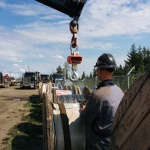
The scales are inexpensive compared to a damaged crane, + it allows the operator to verify the weight to the …load chart, something your operators NEED to be looking at more often. Mention this post and get 10% off of the scale purchase.